


A machine for cleaning fuel injectors enables technicians to clean, test and assess the injectors and proper adjustment enhances the cleaning outcome as well as safeguards the machine against damage.
Modern fuel injectors are capable of building up carbon deposits, varnish, dirt, and internal restrictions. This can have an effect on fuel delivery and on engine performance.
A professional injector cleaner uses ultrasonic cleaning together with injector testing and is able to measure spray patterns, flow rates, leakage, resistance, and injector response.
The guide covers the setting up and use of fuel injector cleaner, the tools that are required, the cleaning procedure, common problems, and the choice of machinery. It also gives reasons showing why the GATmatic injector cleaning equipment is suitable for professional automotive workshops.
What is a fuel injector cleaner and tester?
A specialised piece of equipment for automotive service is used for cleaning and testing fuel injectors which have been removed under controlled conditions.
The machine is capable of simulating injector operation by means of adjustable pulse signals, after which technicians can compare the injector’s performance both before and after it has been cleaned.
Professional machines commonly provide:
- Ultrasonic injector cleaning
- Injector flow testing
- Spray pattern testing
- Leakage testing
- Resistance testing
- Pulse testing
- Reverse flushing
- Automatic testing programs
- Adjustable testing pressure
- Multiple injector voltage settings
GATmatic provides professional automotive workshops with injector cleaner and tester equipment; the equipment currently available covers GDI, conventional, motorcycle, and advanced injector applications.
GATmatic Injector Cleaners

GI-400M Motorcycle Injector Cleaner & Tester
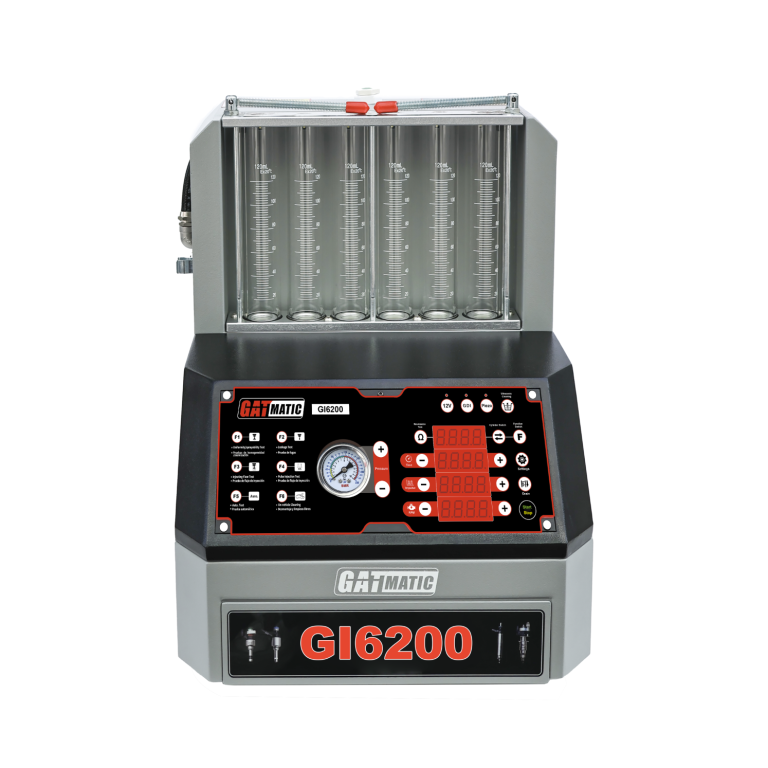
GI6200 Piezo & GDI Injector Cleaner & Tester
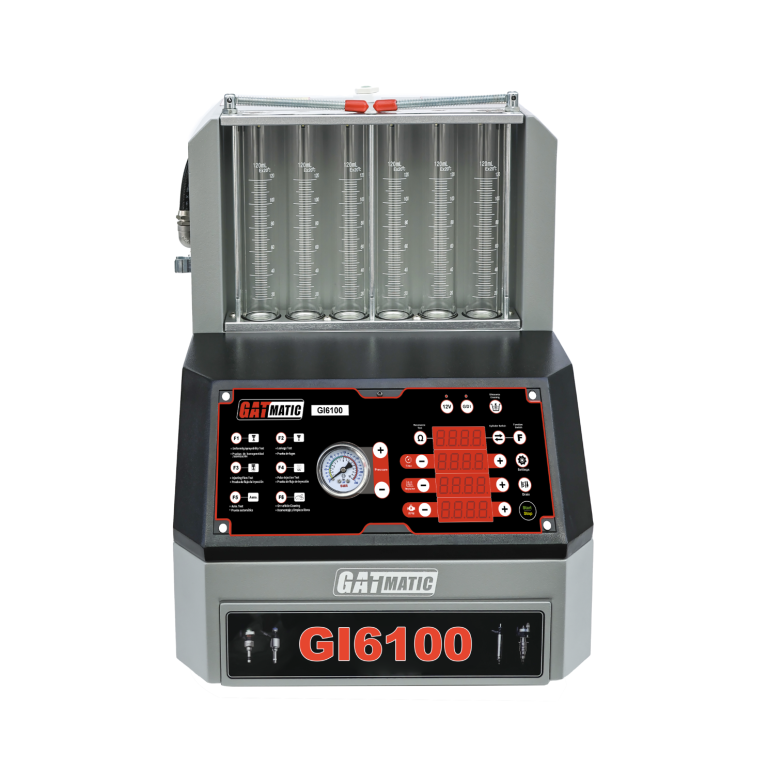
GI6100 GDI Injector Cleaner & Tester
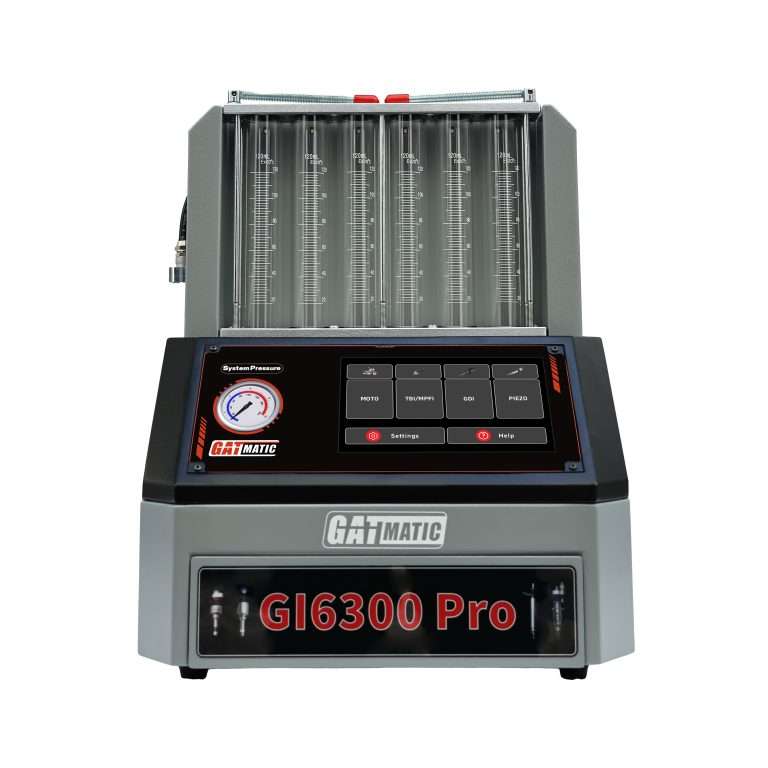
GI6300 Pro Piezo & GDI & Motocycle Injector Cleaner & Tester
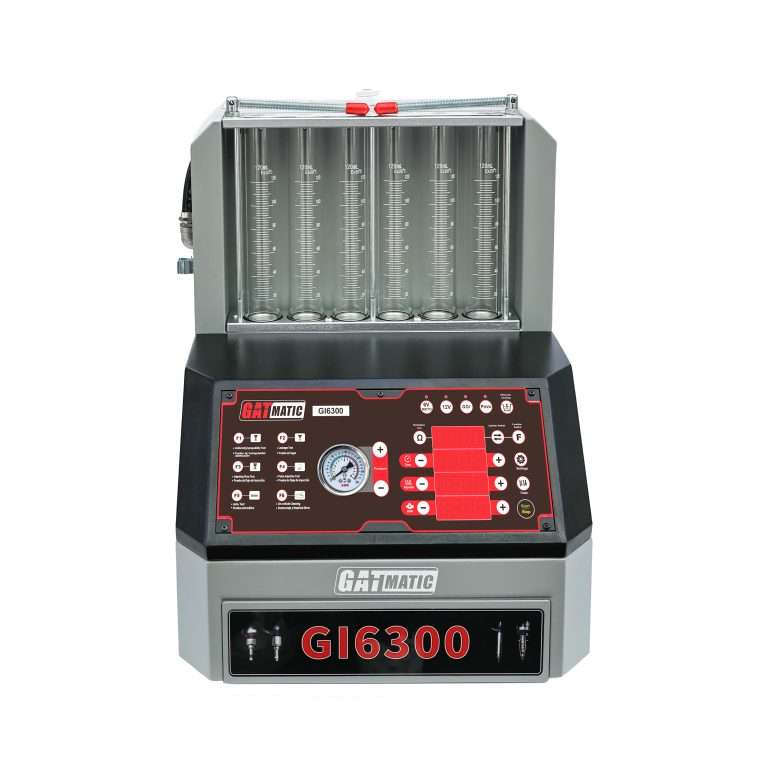
GI6300 Piezo & GDI & Motocycle Injector Cleaner & Tester
What is the reason that fuel injectors need to be cleaned by professionals?
Fuel injectors work under tough conditions and contamination of the fuel together with deposits can slowly impact the performance of the nozzle.
Common symptoms include:
- Rough engine idle
- Hard starting
- Poor acceleration
- Engine misfires
- Increased fuel consumption
- Uneven engine performance
- Poor fuel atomization
- Increased exhaust emissions
- Reduced engine power
A professional cleaning machine can determine if the deposits were the cause of the issue and also helps to avoid the need for unnecessary injector replacement.
Fuel Injector Cleaner Setup and Use: What You Need
Prepare the following equipment before starting:
| Equipment | Purpose |
| Injector cleaner and tester | Cleans and tests injectors |
| Ultrasonic cleaning solution | Removes deposits |
| Approved testing fluid | Supports injector testing |
| Injector adapters | Connect different injector designs |
| Pulse cables | Operate injectors during testing |
| O-rings | Replace damaged injector seals |
| Cleaning brushes | Remove external dirt |
| Safety glasses | Protect the eyes |
| Chemical-resistant gloves | Protect the hands |
| Clean workshop bench | Provides a stable working area |
Before connecting an injector you should always refer to the machine’s manual.

Fuel Injector Cleaner Setup and Use: Preparing the Machine
Begin by positioning the machine on a stable and level workshop bench.
Stay away from excessive dust, water, and direct heat when keeping the equipment. Make sure there is sufficient space around the machine for ventilation and for servicing.
Before turning on the machine, connect the right power supply and check the voltage requirements for your particular model.
Check the hoses, adapters, pulse cables, valves, and connectors. Substitue any damaged parts before carrying out operation.
Make sure that the cleaning fluid and the testing fluid are kept in different containers and do not replace the cleaning chemicals with the approved testing fluid.
MRCARTOOL suggests that you use testing fluids which contain more than 95% alcohol or other appropriate professional testing fluids and cautions you against using corrosive testing liquids.
What amount of workshop space is required by a fuel injector cleaner?
The best arrangement for injector cleaning equipment is one that has a dedicated workbench.
You shouldn’t base your calculation of space on the machine’s physical footprint alone; you must leave room for the injector adapters, the cleaning containers, the tools, and the fluid handling.
A practical workstation should provide:
- Machine footprint
- Front operating clearance
- Side access for hoses
- Rear access for electrical connections
- Storage for adapters
- Storage for cleaning chemicals
- Space for removed injectors
A compact injector cleaner can generally be placed on a dedicated bench area, while more substantial professional models might need a wider equipment bench.
When designing a permanent work station you should always use the machine dimensions given by the manufacturer.
Fuel Injector Cleaner Setup and Use: Ultrasonic Cleaning
Ultrasonic cleaning is able to remove deposits from hard-to-clean injector surfaces by means of high-frequency sound waves being used within the cleaning solution.
Follow these general steps:
1. Remove the Injectors
Take the injectors out following the procedure set out by the vehicle manufacturer.
Check each injector for any cracks, damaged connectors, signs of corrosion, and damaged seals.
2. Clean the outside of the injector
Before putting the injector into the ultrasonic tank, clean the outside thoroughly to remove the dirt.
This stops the cleaning solution from being excessively contaminated.
3. Connect the pulse cables.
Attach the correct pulse cables to the injectors.
When servicing GDI or other special injectors, use the right adapter.
4. Fill the ultrasonic tank
Mix in the suggested injector cleaning solution.
Ensure that the fluid is kept away from the electrical connections and the pulse cable points.
You should not use an ultrasonic cleaner unless there is an adequate amount of cleaning fluid.
5. Start Ultrasonic Cleaning
Choose the ultrasonic cleaning function.
Adjust the cleaning time in accordance with the machine instructions and the condition of the injector.
A number of professional systems set their initial cleaning cycle at about 10 minutes.
6. Inspect the Results
After cleaning, the injectors should be removed and inspected.
In some cases it may be necessary to carry out another controlled cleaning cycle.
Fuel Injector Cleaner Setup and Use: Reverse Flushing
Reverse flushing involves sending the cleaning fluid through the injector in the opposite direction.
It is possible for this method to eliminate particles that are caught around the injector nozzle.
Follow these steps:
- Choose the right injector adapter.
- Attach the adapter to the outlet of the injector.
- Install the support rack.
- Connect the oil distributor.
- Join the right pulse cable.
- Put the injector in reverse.
- Select the reverse-flushing function.
- Carry out the suggested cleaning cycle.
- After flushing, check the injector.
Make sure you are using the right adapter size since an inadequate connection may result in fluid leakage when flushing.
Fuel Injector Cleaner Setup and Use: Injector Testing
Cleaning should usually be followed by testing.
Tests are carried out to find out if the cleaning really enhanced injector performance.
A typical testing sequence includes:
Resistance Test
The machine measures the electrical resistance of the injector.
A reading that is abnormal may point to an electrical problem.
Leakage Test
The machine puts pressure into the injector and tests its sealing performance.
An injector which is leaking might drip fuel even though it should be closed.
Spray Pattern Test
The testing fluid is sprayed into a graduated cylinder by the injector.
A healthy injector must give a consistent spray pattern.
An irregular pattern may be a sign of contamination or of injector damage.
Flow Rate Test
The machine calculates how much fluid is delivered over a specified period.
Technicians are able to compare each injector in order to detect any differences in flow.
Pulse Injection Test
The machine causes the injector to operate by means of controlled pulse signals.
The purpose of this test is to assess how the injector responds when operating conditions are simulated.
GATmatic regards spray pattern, flow rate, leakage, resistance, and pulse testing as essential functions for the evaluation of injectors.
Fuel Injector Cleaner Setup and Use: Before-and-After Testing
If possible, always test the injectors before cleaning them.
Record the initial results.
Clean the injectors and then carry out the same tests again.
This allows for a comparison that can be measured.
Before cleaning → Ultrasonic cleaning → Reverse flushing → Retesting → Compare results → Reinstall
The workflow offers more evidence than cleaning without testing.
What benefits does the GATmatic Fuel Injector Cleaner Equipment offer?
GATmatic specializes in professional automotive workshop equipment and injector cleaning systems.
The injector equipment offered includes both GDI and conventional injector cleaners, and the range also covers advanced Piezo and motorcycle applications.
GATmatic claims that it possesses more than 13 years’ experience in the automotive aftermarket sector and that it provides services to customers in over 50 countries and regions.
Key advantages include:
- Ultrasonic cleaning technology
- Multiple injector applications
- Comprehensive testing functions
- Professional workshop design
- Manufacturer support
- International distribution experience
- Engineering and quality-control capabilities
- Product documentation and manuals
The GI6300 Pro is aimed at use with Piezo, GDI, and motorcycle injectors and GATmatic includes user manuals for its injector cleaner models.

GATmatic Injector Cleaner Features to Consider
The appropriate GATmatic model will depend on the injectors that your workshop works with.
Look for features such as:
Ultrasonic Cleaning
Ultrasonic technology can be used to remove deposits from the surfaces of injectors and from their internal passages.
Multi-Injector Testing
Testing a number of injectors at the same time improves workshop efficiency and makes the comparisons easier.
Adjustable Pulse Width
Technicians can adjust the pulse control to simulate various operating conditions.
Adjustable Testing Pressure
Adjusting the pressure enables technicians to carry out controlled testing of the injectors.
Multiple Test Programs
Automated test programs have the ability to cut down on the need for repetitive manual setup.
Transparent Measuring Cylinders
Technicians can visually compare the injector delivery using graduated cylinders.
Broad Injector Compatibility
Advanced models are suitable for use with conventional, GDI, Piezo, and motorcycle injectors.
Common Fuel Injector Cleaner Problems and Solutions
| Problem | Possible Cause | Recommended Action |
| Poor spray pattern | Blocked nozzle | Clean and retest |
| Low flow | Internal restriction | Perform ultrasonic cleaning |
| Injector leakage | Worn internal component | Test and replace if necessary |
| Fluid leakage | Wrong adapter | Install the correct adapter |
| Machine pressure drops | Hose or connection problem | Inspect connections |
| Injector does not pulse | Wrong cable or voltage | Check connection and voltage |
| Poor cleaning results | Contaminated fluid | Replace cleaning solution |
| Unstable test results | Dirty testing fluid | Drain and replace fluid |
| Ultrasonic system fails | Insufficient fluid | Fill the tank correctly |
| Injector remains faulty | Mechanical or electrical failure | Replace the injector |
It is not possible for cleaning to fix all injectors; in some cases, such as when the coil is damaged, an internal part is broken, or there is a serious mechanical failure, the injector will have to be replaced.
How to Maintain a Fuel Injector Cleaner Machine
Proper maintenance not only prolongs the life of the equipment but also enhances the accuracy of the tests.
After each service, clean the work area.
Replace contaminated testing fluid.
Make sure the ultrasonic tank is cleaned regularly.
Check the hoses and adapters for any damage.
Before carrying out operation, check the electrical cables.
Stay away from connectors when using cleaning fluid.
If the machine is to remain in use for a long time, drain the fluids.
Adhere to the manufacturer’s recommended maintenance timetable for the filters, pumps, seals, and all other components.
Who should purchase a fuel injector cleaner?
Several businesses can benefit from using a professional injector cleaner.
Automotive Repair Workshops
Workshops are able to diagnose problems with injectors and also offer injector cleaning services.
Engine Specialists
It is possible for people who rebuild engines to test the injectors before installing the engine.
Fuel Injection Specialists
Specialists who work on injectors need precise testing of flow, spray, and leakage.
Motorcycle Repair Shops
Models that support motorcycle injectors can increase their service capabilities.
Dealership Workshops
Injector testing can be used by dealerships as part of a systematic diagnosis of the fuel system.
Automotive Training Centers
Training establishments can show how injectors work and how to carry out the testing procedures.
Fleet Maintenance Companies
Fleet operators have the option of carrying out injector testing in order to detect faults in the fuel system.

Fuel Injector Cleaner vs Fuel Additive
Fuel additives are taken into the fuel system via the vehicle’s fuel tank.
A professional injector cleaner offers controlled Fuel additives can aid with regular maintenance, but they cannot take the place of professional injector testing if serious symptoms occur.g How frequently should fuel injectors be cleaned?There is no single cleaning schedule that applies to all vehicles. The quality of the fuel, the way far the vehicle goes, the design of the engine, the conditions under which it is driven, and the state of the injectors are all important. GATmatic suggests cleaning intervals of about 30,000 to 50,000 miles for certain GDI applications, but technicians should still adhere to the recommendations specific to each vehicle.hicle-specific recommendations.
When the vehicle starts to show symptoms such as misfires, poor acceleration, a rough idle, or abnormally high fuel consumption, clean the injectors earlier.
Safety Tips for Fuel Injector Cleaner Setup and Use
Follow these safety practices every time:
- Wear chemical-resistant gloves.
- Wear suitable eye protection.
- Do not leave ignition sources near flammable fluids.
- Use approved cleaning chemicals.
- Maintain good workshop ventilation.
- You should never use ultrasonic equipment unless there is a fluid present.
- Don’t use the wrong injector adapter.
- Do not go beyond the pressure that is specified for the machine.
- Apply the right injector voltage.
- Before carrying out any servicing of electrical components, make sure the power is disconnected.
Do not use unknown chemicals or adapters arbitrarily.
Frequently Asked Questions
Can a machine which cleans fuel injectors be used to clean the injectors on a GDI engine?
Yes, professional models that are compatible can clean and test GDI injectors.
You should always check that the equipment is compatible before buying it.
Is it possible for one machine to clean all the fuel injectors?
It is not valid to assume that a machine supports every type of injector.
Make sure that it is compatible with conventional, GDI, Piezo, motorcycle, or other types of injectors.
Can cleaning the injector cure a faulty injector?
Usually not.
While cleaning can get rid of deposits it cannot remedy serious electrical or mechanical damage.
What kind of liquid should I use when testing the injector?
The fluid that is recommended by the machine’s manufacturer should be used.
Do not use aggressive cleaning chemicals as your testing fluid since MRCARTOOL expressly cautions against it.
May I use water in the injector cleaner?
Water should not be used unless it is specifically approved by the manufacturer.
Use the cleaning solution that is recommended for your machine.
What causes an injector to continue to fail after it has been cleaned?
The injector could have suffered electrical damage, mechanical wear, damaged seals, or an enduring internal failure.
Before making a decision on replacement, it is necessary to compare the test results before and after.
Does ultrasonic cleaning perform better than manual cleaning?
The cleaning process using ultrasonic waves goes beyond what can be achieved through simple external washing.
It too can be used in the case of controlled testing when the machine carries out both the cleaning and the testing functions.
Can cleaning injectors lead to an increase in the workshop’s revenue?
Correct. Workshops may provide injector testing and cleaning as extra paid services.
It also aids technicians in more efficiently diagnosing complaints concerning the fuel system.
Final Verdict: The Best Approach to Fuel Injector Cleaner Setup and Use
The way in which the setup is arranged has a bearing on the quality of the injector cleaning and testing.
A good professional workflow must include inspection, cleaning, testing, and retesting.
The most effective process is:
Inspect → Test → Ultrasonic Clean → Reverse Flush → Test Again → Compare → Reinstall
For workshops seeking professional injector service equipment, GATmatic provides a broad range of injector cleaner and tester solutions. Its equipment covers conventional, GDI, Piezo, and motorcycle applications across different models.
Choosing the correct model depends on your injector types, workshop workload, available space, and required testing functions.
A properly configured injector cleaning station can improve diagnostic accuracy, expand workshop services, and help technicians restore fuel delivery performance efficiently.
Related Post

2 Essential Tools Experts Use to Prevent Scratching Expensive Alloy Wheels

GATmatic at Automechanika Shanghai 2026: Discover Advanced Wheel Alignment & Workshop Solutions

How to Remove a Tight Car Tire from a Wheel: Mechanic’s Guide

4 Must-Have Tire Repair Equipment for Every Workshop

Best Tire Changer Machine for Workshops
