


In order to be successful, a tire workshop must have more than just the basic tools needed for puncture repair; customers also expect accurate wheel balancing, professional tire installation, and dependable wheel alignment. Appropriate equipment enables the technicians to carry out these services efficiently and with confidence.
Selecting the right workshop machinery, on the other hand, can be difficult since different types of machines are used for different tasks and if you buy the incorrect equipment then this will restrict the range of services you can provide. A properly equipped workshop should include not only the basic tire repair tools but also machines which enhance the quality of the services offered.
GATmatic provides automotive workshop equipment such as automatic tire changers, wheel balancers, touchless wheel alignment systems, and tool storage solutions. These products enable workshops to establish a more organized and capable service operation.
The guide looks at four essential categories of tire repair equipment, examining their main features and explaining how to select the appropriate ones for your business.
What counts as tire repair equipment?
The equipment used for tire repair consists of machines, tools, and accessories which are used for inspecting, repairing, installing, balancing, and maintaining vehicle tyres. Some of the tools are used for dealing with punctures, whereas others are for carrying out full wheel servicing.
Professional workshops usually need equipment for a number of closely related services, such as tire mounting, wheel balancing, alignment checks, inflation, and routine maintenance.
The combination you choose will depend on your customers, the amount of workspace you have, and the level of service you provide. For instance, a busy tire center will probably need automated machinery, while a small garage could start by getting basic equipment and then expand slowly.
1. Fully Automated Tire Repair Equipment: Tire Changer Machine
A tire changer is one of the most important machines used in a modern tire workshop since it is capable of removing tyres from the rims and fitting new tyres onto the wheels.
Methods that are manual involve a great deal of work and may increase the chance of damaging the rims. Using an automatic tire changer enables technicians to carry out these tasks with better control and greater efficiency.

TWC700 Fully Automatic Car Tyre Changer Machine
● Tilting Column Design for Faster Operation
● Integrated Assist Arm for Difficult Tires
● Wide Rim & Wheel Compatibility
● Powerful Pneumatic Bead Breaker
● Heavy-Duty & Durable Construction
● Alloy Wheel Protection Design
What’s the advantage of the GAT-Matic TWC700 Fully Automatic Tire Changer?
The GATmatic TWC700 Fully Automatic Car Tyre Changer is made with professional workshops in mind, particularly those that need efficient tire-changing operations.
Its key features include:
- The automatic tilting column makes it easier to load and mount the wheels.
- The integrated assist arm provides support to technicians when dealing with demanding tire profiles.
- A pneumatic bead breaker is useful for separating the tire bead from the rim.
- It is compatible with a wide range of rim sizes as long as they are within the specified limits.
- Alloy wheel protection: clamps with protective covers help to reduce the risk of scuffs to the wheel rim.
- Built for heavy use: Suitable for ordinary workshop applications.
- The controls are ergonomic since they include foot pedals which allow technicians to manage the various operating functions.
The TWC700 can be used with externally clamped rims that range from 10 to 20 inches in size, and its internal clamping range is from 13 to 26 inches. The machine also supports wheels with a diameter of up to 1,100 mm.
It is worthwhile considering these specifications for use in passenger cars, SUVs, and light commercial vehicles. You should always check that they are compatible with the kind of tyres you plan to buy.
Benefits of a Fully Automated Tire Changer
In the first place, automation eliminates repetitive manual tasks so that technicians can concentrate on carrying out the proper mounting procedures and providing customer service.
Another feature is the presence of an assist arm, which helps with difficult tire profiles, especially in the case of low-profile and run-flat tires.
In the end, appropriate rim protection helps to reduce accidental cosmetic damage and proper training together with the right machine settings is still essential.
Look through the range of GATmatic tire changers to compare the different models.
2. Professional Tire Repair Equipment: Wheel Balancer
A wheel balancer is able to detect an uneven distribution of weight in a wheel and its tyre. The technicians then deal with the imbalance by using the appropriate wheel weights.
Unbalanced wheels may lead to vibration in the steering wheel, uneven wear on the tyres, and a decrease in driving comfort. Because of this, wheel balancing is an essential service following numerous tyre installations.


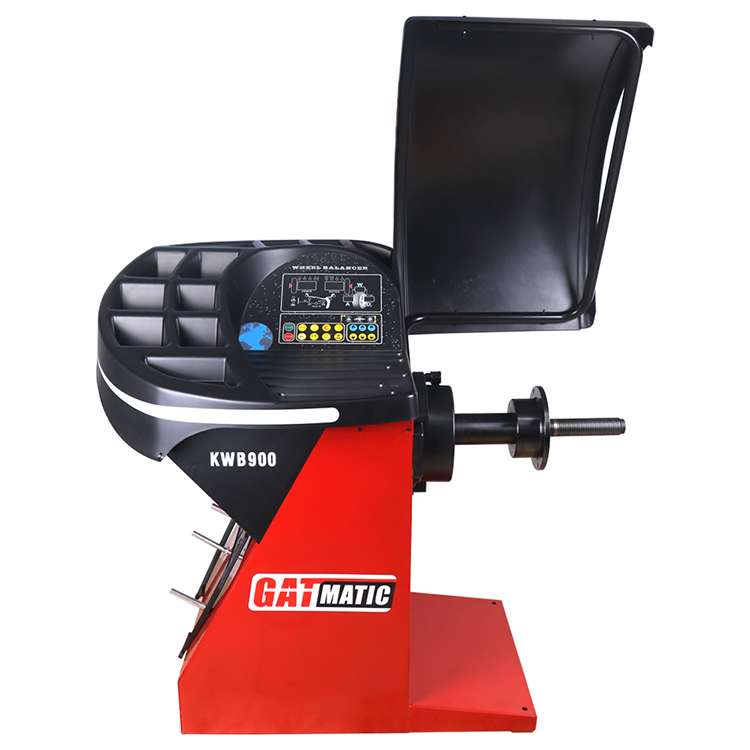


KWB900 High-efficiency Automotive Wheel Balancer
● Integrated LED Display and Control Panel
● Automatic Wheel Width Detection
● User-Friendly Interface
● High Precision Balancing
● Versatile Application
● Enhanced Workflow Efficiency
GAT-Matic KWB900 Wheel Balancer Features
The GATmatic KWB950 Wheel Balancer is intended for use in professional automotive workshops.
Its main features include:
- There are 13 balancing modes: these accommodate various balancing needs, such as dynamic, static, and alloy-wheel modes.
- The touchscreen interface means that the operating functions are easier to access.
- The system automatically inputs the measurements of the selected wheels.
- Self-calibration aids in keeping the measurements consistent.
- The balancing precision is high since the manufacturer has specified an accuracy of ±1 gram.
- The motor has a low noise level and this helps to create a more comfortable working environment.
- The motorcycle settings offer extra versatility for motorcycle wheels that are compatible.
The machine known as the KWB950 can run at speeds of up to 195 RPM, and the combination of its automated measurement facilities with its various balancing modes makes it suitable for use in workshops that work with different kinds of wheels.
Why Every Tire Shop Needs a Wheel Balancer
A tire changer fits the tyres but doesn’t remedy any imbalance of the wheel; it is necessary to use a separate balancing machine in order to carry out this vital part of wheel servicing.
Correct balancing contributes to better driving comfort and helps to reduce the vibrations resulting from imbalance; it also enables technicians to determine the necessary weight adjustments before sending the vehicle back.
When running workshops that deal with different types of vehicles, you should select a balancer that is suitable for the wheel sizes and weights of your customers.
GATmatic also provides the KWB900 High-Efficiency Automotive Wheel Balancer; you should compare the specifications of the KWB950 with those of the KWB900 before deciding on a model.
3. Advanced Tire Shop Equipment: Touchless Wheel Alignment Machine
The wheel alignment apparatus compares the angles of the wheels with the predetermined alignment specifications for the vehicle. If the alignment is incorrect it may lead to uneven tire wear and steering issues.
With traditional systems technicians are required to fit measuring targets or clamps onto the wheels, whereas a touchless system measures wheel alignment without the need to use the conventional wheel-mounted targets.

GA-800 Ultra B Touchless Wheel Alignment System
● Short-Post Design – Ideal for Pit or Ground-Level Installation
● Adjustable Sliding Rails – Wider Wheelbase Coverage
● Ultra-Fast Measurement – Toe, Camber, and Thrust in 1.5s
● Strong-Light Resistance – Stable Measurements
● Touchless Design – No Clamps or Wheel Contact
● No Run-Out Compensation Required
● Flexible Connectivity – Cable or Wi-Fi
GAT-Matic GA-800B Touchless Wheel Alignment System
The GATmatic GA-800B Touchless Wheel Alignment System makes use of cameras, laser technology, and 3D imaging.
Its main features include:
- Contactless measurement eliminates the use of conventional measuring clamps fitted to the wheel.
- With rapid scanning, the manufacturer says that the results of the measurement can be obtained in 1.5 seconds.
- The camera provides wheel images for the purpose of alignment analysis.
- The vehicle database allows technicians to choose the correct vehicle specifications.
- The alignment measurements include parameters such as toe, camber, caster, and thrust angle.
- Space-conscious design provides an alternative to certain traditional alignment arrangements.
The GA-800B will assist workshops in streamlining their alignment checks, but the time taken for the measurement does not include the entire service time.
The technicians have to inspect the vehicle, evaluate the results, carry out any required adjustments, and then check the final readings.
Why Touchless Wheel Alignment Equipment Is Worth Considering
Since contactless measurement does not require the use of conventional targets on the wheels, the measurement procedure can be simplified and some of the handling risks can be reduced.
It also provides chances for workshops that want a modern alignment service, but correct installation, calibration, coverage of the vehicle database, and technician training are still important.
Select a system that suits the arrangement of your workshop and the kinds of vehicles you handle. Make sure it is compatible with your alignment bay, lift, and the operating conditions required.
4. Essential Tire Repair Tools: Tool Trolley and Cabinet
Although powerful machines are important, technicians also need reliable hand tools and a tool trolley or cabinet helps to keep the tools that are used frequently organized and easy to access.
Technicians could waste time looking for sockets, wrenches, and other accessories if there is not adequate storage, and bad organisation might lead to tools being misplaced.
GATmatic Tool Trolley and Cabinet Options
GATmatic provides a number of options for garage storage, such as the GEC403, GEC405, GEC307, GEC807, and GEC901 models.
You are able to look at them using the GATmatic tool trolley and cabinet range.
Depending on the selected model, useful considerations include:
- The drawer trays allow tools to be sorted by their type and size.
- For mobile design, technicians can move the tools about in the workshop.
- Having properly organized workstations helps to ensure that tools are placed consistently.
- Designed for heavy use: It is suitable for demanding workshop conditions.
- Certain cabinets include extra workspace.
- Some designs come with features like pegboards.
Before you place your order, make sure to check the dimensions of each model, the capacity of the drawer, the design of the wheels, and the accessories that are included.
GATmatic Tool Trolley
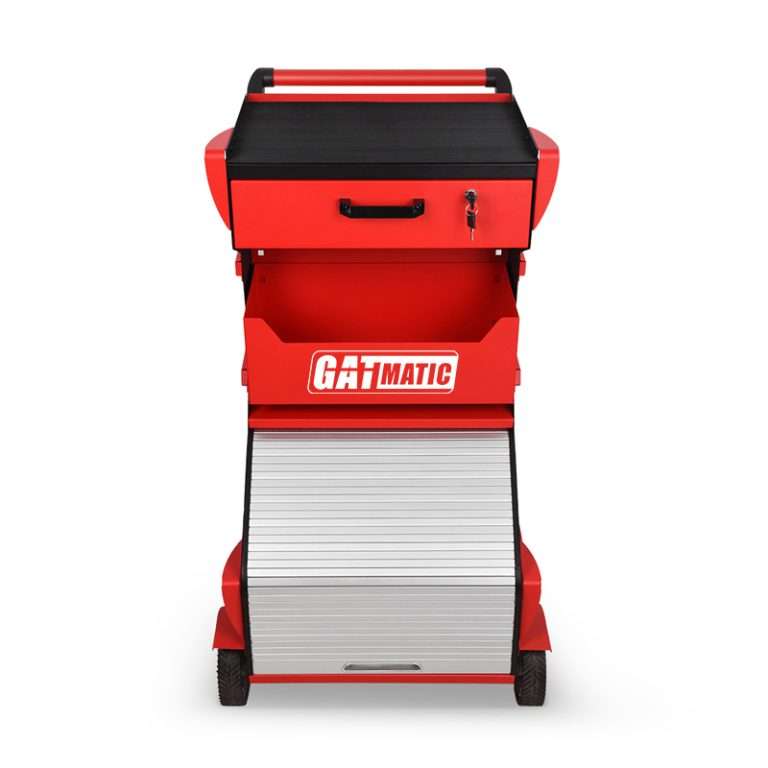
GEC403 Multi-functional Tool Trolley with New Appearence
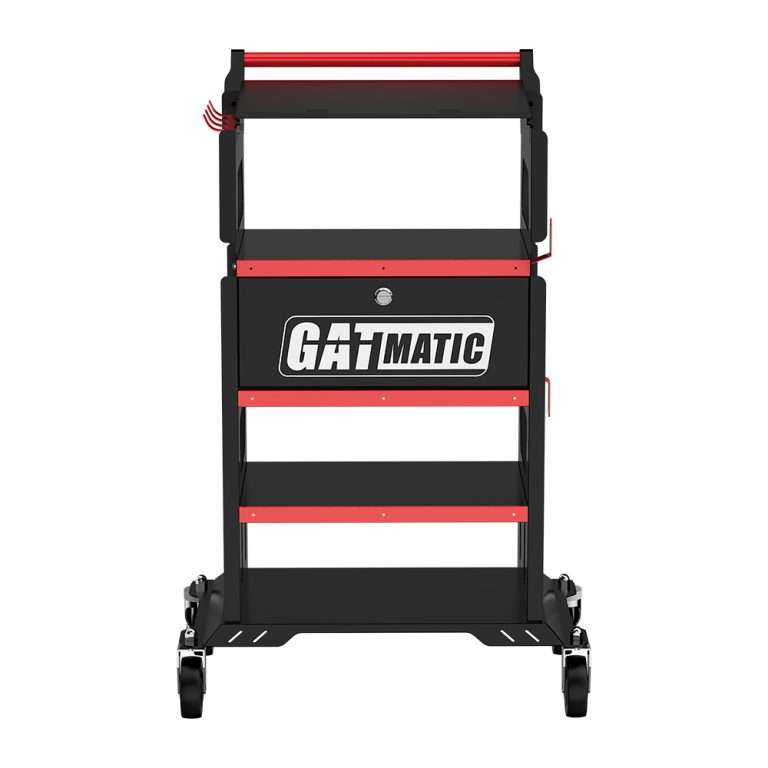
GEC405 Multifunctional Programming Tool Trolley
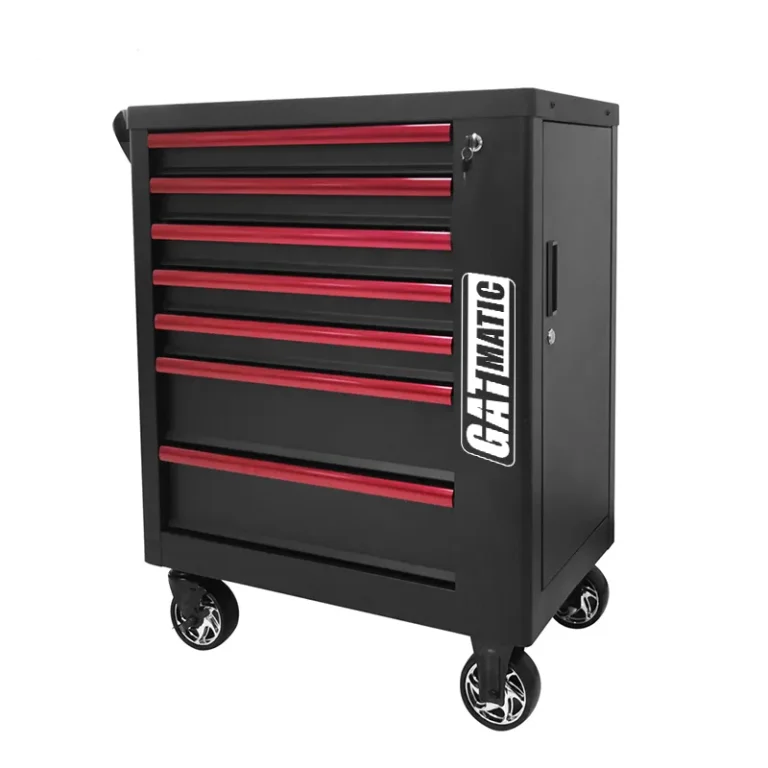
GEC307 7-Drawer Empty Cabinet Multi-Functional Tool Trolley
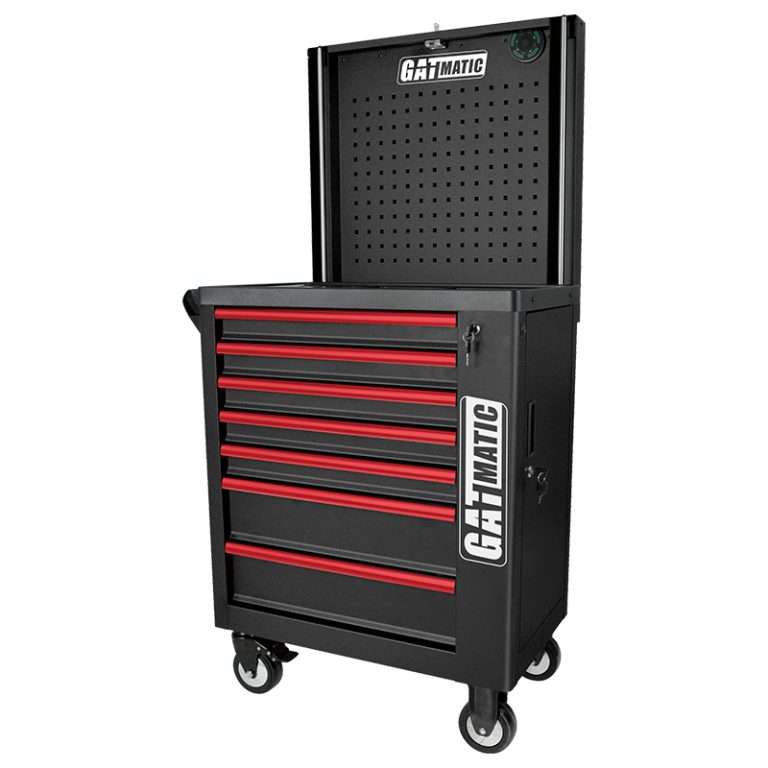
GEC807 Automatically Lifting Pegboard Tool Trolley
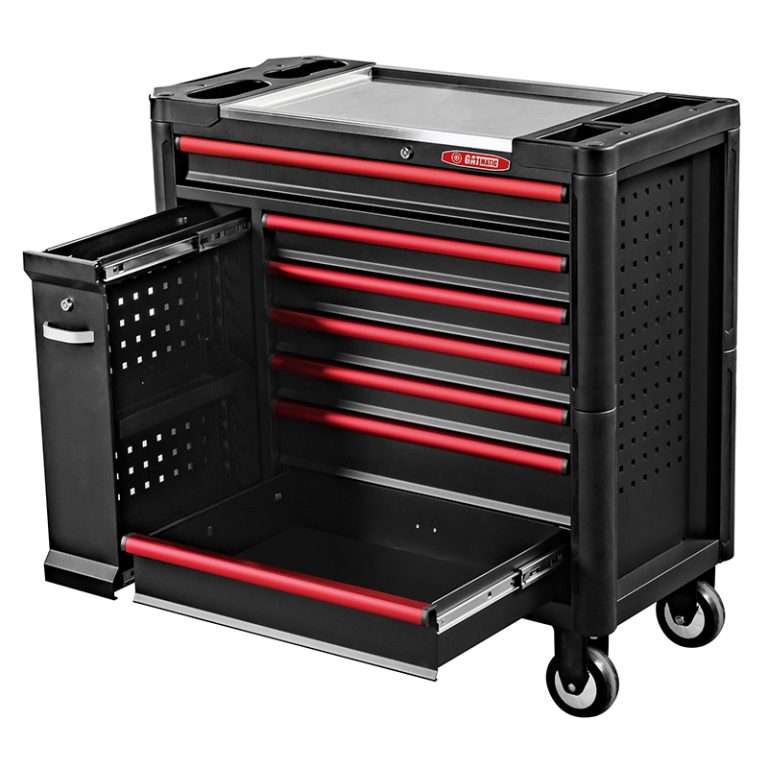
GEC901 Heavy-duty Rolling Tool Cabinet Steel Worktop
Why Tool Organization Matters
A well-organized workstation allows technicians to find their tools quickly and also contributes to a more professional working environment.
For instance, technicians can store items such as wheel weights, valve tools, sockets, and measuring accessories in specific places and then put each one back after finishing a job.
An appropriate cabinet also serves to prevent tools from suffering unnecessary exposure and damage. The type of storage you select should be based on your present inventory and on your future requirements for the workshop.
Other Tire Repair Tools Every Workshop Should Have
The foundation outlined in the four equipment categories is good but a fully equipped tire service operation also requires smaller tools and safety accessories.
| Equipment | Main purpose |
| Tire pressure gauge | Checks tire inflation pressure |
| Air compressor | Supplies compressed air to compatible equipment |
| Tire inflator | Helps inflate tires to the specified pressure |
| Valve tools | Support valve core and valve stem servicing |
| Tire repair kit | Supports approved puncture repair procedures |
| Bead lubricant | Helps with appropriate tire mounting procedures |
| Wheel weights | Correct wheel and tire imbalance |
| Torque wrench | Tightens wheel fasteners to specified torque |
| Wheel lifting equipment | Supports safe handling of heavy wheels |
| Safety equipment | Protects technicians during service operations |
To carry out professional repairs for a tire, it is necessary to have the appropriate patches, plugs, preparation tools, and repair materials. You must observe the tire manufacturer’s repair limits and follow the approved repair methods.
It is not always possible to repair a damaged tyre safely, since damage to the sidewall, considerable structural damage, and punctures outside the approved repair areas all may mean that the tyre has to be replaced.
How to Choose the Best Tire Repair Equipment
Getting workshop equipment involves more than just comparing prices, so you should take these factors into account before making your decision.
1. Identify Your Main Services
You need to decide on whether your workshop will specialise in puncture repairs, in replacing tyres, in balancing, in alignment, or in carrying out complete wheel servicing.
The range of services decides which machines should be given priority.
2. Check Vehicle and Wheel Compatibility
Check the diameter of the machine’s wheels, the width of the rim, the weight of the wheel, and the limits regarding vehicle compatibility. Workshops specialised in heavy commercial vehicles require different capabilities than passenger car garages.
3. Evaluate Automation and Productivity
Machines capable of working automatically can cut down on repetitive tasks; but automation only provides value when the machine is suitable for the kind of work being done and for the capabilities of the staff.
4. Confirm Power and Installation Requirements
Make sure that the voltage, the phase requirements, the compressed-air pressure, the floor space, and the installation conditions are checked since these points are particularly important when installing equipment in a new workshop.
5. Consider Training and After-Sales Support
Inquire as to the matter of installation, operator training, spare parts, maintenance, warranty coverage, and technical assistance and make sure that these arrangements have been confirmed before you place your order.
6. Compare Total Ownership Costs
When evaluating the purchase price, you should also take into account the cost of installation, the accessories, maintenance, electricity, and replacement parts. The machine you choose should be able to meet your business needs over time.
What benefits does GATmatic Tire Repair Equipment offer?
GATmatic provides a variety of machinery and tools for use in automotive workshops across a number of equipment types. The products it offers consist of tire changers, wheel balancers, touchless alignment systems, hand tools, and storage cabinets.
Because of the wide range of options available, customers can compare different workshop solutions from the same supplier.
The equipment available from the company also provides various options for workshops that have different needs; for instance, customers can compare the TWC700 tyre changer, the KWB950 wheel balancer, and the GA-800B touchless alignment system.
Instead, these models carry out different functions rather than competing for the same role, and as a result appropriate machines can enable a more complete wheel service operation.
Before you buy, check the technical specifications and make sure they are compatible with your workshop. Also ask for the up-to-date prices, the delivery arrangements, the warranty conditions, the details regarding installation, and the support that is available.
Start off with the official GATmatic product catalogue.
Who ought to purchase professional tire repair equipment?
The equipment used by professional tire repair services can be advantageous for a number of different businesses.
- For car tire shops, it is necessary to have equipment available for mounting, balancing, inflating, and repairing punctures.
- Automotive repair shops have the possibility of extending their range of services to include wheel balancing and alignment.
- Car dealerships may need to have dedicated wheel service equipment in their maintenance departments.
- It is possible to provide in-house maintenance services for vehicles that are compatible with the fleet.
- People who have set up new workshops can establish a service operation based on their target customers.
- Distributors of automotive equipment can assess machinery that is suitable for their markets.
The optimal arrangement will vary according to the level of service demand, the amount of money that is available for investment, and the types of vehicles you plan to service.
Frequently Asked Questions About Tire Repair Equipment
What kind of equipment does a professional shop for tire repairs require?
A professional workshop generally requires a tire changer, a wheel balancer, an air compressor, an inflator, a pressure gauge, and tools for repairing punctures; moreover, those workshops which provide alignment services must have an appropriate alignment system.
What is the difference between a person who changes tires and one who balances wheels?
A tire changer is used for taking off and fitting tires onto rims, while a wheel balancer checks for an uneven distribution of weight and determines the required corrective weights. The two types of machines carry out different functions but are complementary to one another.
Is the touchless wheel alignment machine superior to a traditional system?
By using a touchless system conventional wheel-mounted measuring targets can be eliminated. This approach could make taking measurements easier and reduce the number of handling steps. Yet the most suitable option will vary according to the accuracy requirements, the installation conditions, the software, the support available, and the budget.
What GATmatic tire changer should I go for?
If you are looking for an automatic tire changer that has a tilting column and an integrated assist arm, then the TWC700 is worth considering. You should compare its specifications with those of other models before making your choice.
What is the cost of professional tire repair equipment?
Prices vary by machine type, automation, capacity, configuration, and supplier. Request a current quotation from GATmatic for the models you intend to purchase.
Where can I buy tire repair equipment?
You can explore available models through the GATmatic official website. Contact the company to confirm pricing, specifications, delivery, warranty, and technical support.
Final Thoughts
The right tire repair equipment helps workshops deliver a broader range of services with greater consistency. A tire changer handles mounting, a wheel balancer corrects imbalance, and an alignment system measures wheel geometry.
A well-organized tool trolley supports technicians throughout these tasks. Together, these four equipment categories provide a practical foundation for a professional tire workshop.
Explore GATmatic’s equipment range and compare models against your service requirements. Select machines that fit your workload, vehicle types, available space, and long-term business plans.
Related Post

2 Essential Tools Experts Use to Prevent Scratching Expensive Alloy Wheels

GATmatic at Automechanika Shanghai 2026: Discover Advanced Wheel Alignment & Workshop Solutions

How to Remove a Tight Car Tire from a Wheel: Mechanic’s Guide

4 Must-Have Tire Repair Equipment for Every Workshop

Best Tire Changer Machine for Workshops
